
Reading Actun Tunichil Muknal history
Actun Tunichil Muknal history includes early Maya use in AD 300 to 600 and later pottery in the Main Chamber dated to AD 700 to 900. These periods describe archaeological evidence from different parts of the cave. They do not assign a single date to every object or every person represented by the human remains. Understanding that distinction makes a visit more meaningful than attaching one dramatic story to the entire site.
ATM Cave is near Teakettle in the Cayo District. The name is translated as Cave of the Stone Sepulcher on the NICH site description dated June 2024. Today, a visit is arranged in advance through a licensed operator with an ATM-certified guide. For the practical decision, use the visitor guide; for the surrounding archaeological landscape, read about Xunantunich outings.
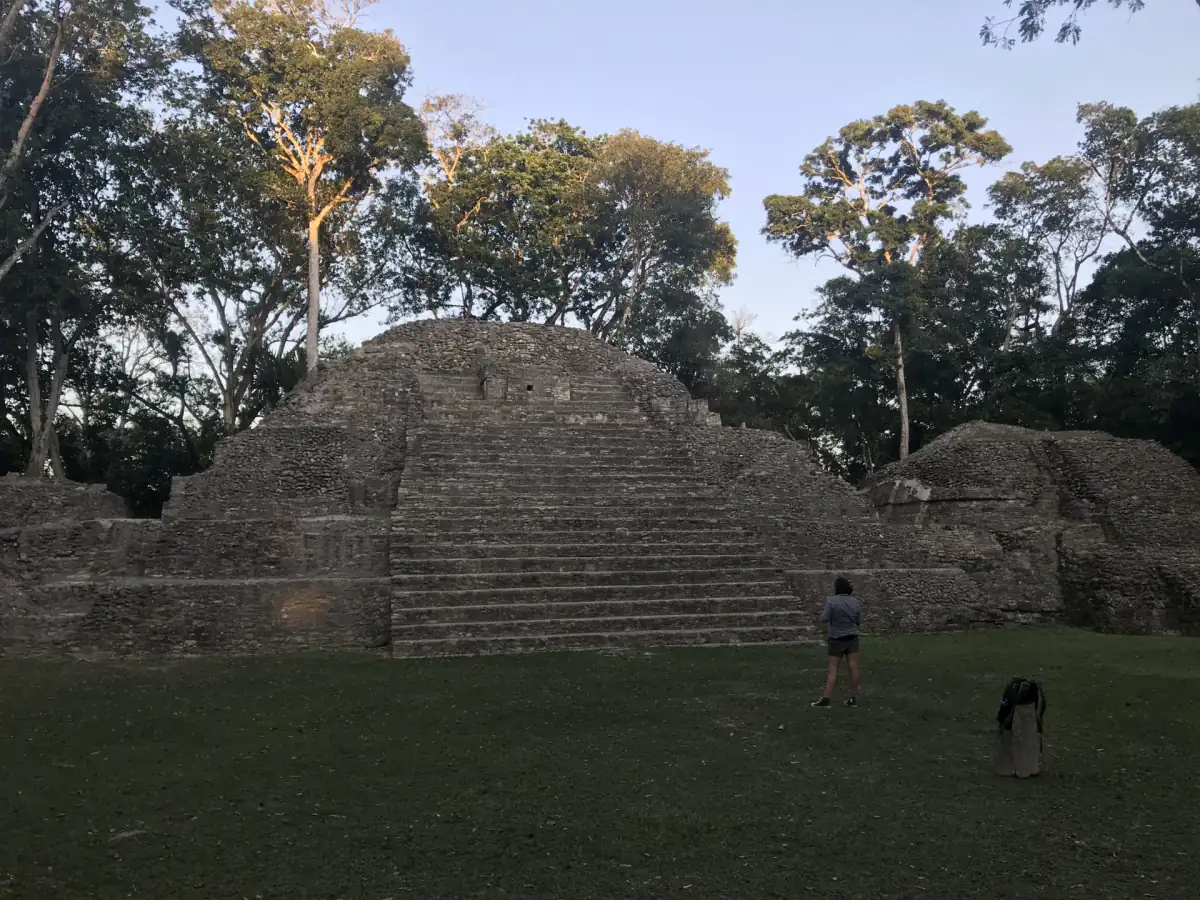
Pottery and the importance of place
The report of the 1998 field season, published in 1999, distinguishes early Hermitage pottery, mainly near the entrance, from pottery identified in the Main Chamber. The latter was assigned to the Spanish Lookout complex of AD 700 to 900. A pottery date helps place activity within a period; it is not an individual radiocarbon date for a skeleton beside it.
The 2004 study by Helmke, Bevan and Awe describes finds retained in their positions and human remains covered by crystalline calcite. Their account concerns the research state at that time. Read it as a description of relationships between objects, remains and the cave, rather than a claim that nothing has changed since ancient Maya use.
This is why the position of an object matters as well as its appearance. A vessel observed beside other material belongs to a wider archaeological setting. During a visit, follow the marked route and the guide’s instructions, and leave artefacts and formations untouched. Careful observation preserves the relationship that makes interpretation possible.
Visit the archaeological cave
Our take: This guided visit includes the entrance fee and equipment.
Hand-picked tours, booked through Viator. Prices are indicative starting prices in US dollars (as of October 2026). Tap a tour for live availability and the current price in your currency.
A guided visit to the archaeological cave
This ATM outing includes a local guide, entrance, necessary equipment, lunch, juice and an air-conditioned vehicle.
Crystal Maiden: a name used in tourism
The ATM Cave Crystal Maiden is a tourist name for a calcite-covered human skeleton. The name is memorable, but it should not be used as a biography. It does not establish age, sex, virginity, a year of death or a cause of death. Approach the remains as those of a person within an archaeological setting, with the same restraint you would bring to any place containing human remains.
The 2004 study discusses human remains and possible sacrificial interpretations. It also explains the difficulty of drawing firm conclusions where injuries are not visible or calcite covers the material. Sacrifice is therefore an interpretation to discuss carefully, rather than a proven death story for every individual. A guide can explain the site without turning that uncertainty into spectacle.
The cave’s archaeological importance reaches beyond the named remains. Pottery, spatial relationships and the surrounding mineral deposits all contribute to understanding it. Give those elements attention instead of treating the visit as a search for a single named sight. Cameras, video equipment and recording devices are prohibited inside ATM, so plan to observe without making images there.
Karst, cave processes and calcite
ATM Natural Monument borders Tapir Mountain Nature Reserve, whose landscape includes lowland forest on karst. Keep those protected areas distinct when reading descriptions of the region. The forest setting gives the cave its geographical context; it does not turn the surrounding reserve into a separate freely accessible walking route.
Calcite is important to the archaeological story because the 2004 researchers describe crystalline coatings formed through cave processes. Those coatings are part of how remains appear today and part of the difficulty of assessing some features beneath them. Consider mineral surfaces and archaeological evidence together. Avoid touching formations or attempting to inspect fragile material more closely than the guided route allows.
Digital documentation and planning a visit
The CAA abstract book of 2026 describes a digital twin of ATM created by combining mobile LiDAR, structured light and photogrammetry, referring also to a 2025 publication. The project includes documentation of remains and pottery near visitor routes. Its interactive public version was described as work in progress. This research concerns recording the site, rather than a bookable visitor experience.
A physical visit still involves swimming, wading, uneven rock and climbing. Good physical health and swimming ability are required, with life vest, helmet and light. Children must meet the national minimum height of 40 inches, or 101.6 cm; an operator’s six-plus condition and another’s twelve-plus recommendation are separate offer requirements. Height alone does not establish suitability.
High water can prevent the tour. Ask about the operating status for your date, and use the prices page to separate admission from the organised package. If you are choosing a base for the journey, San Ignacio provides the local planning context without changing the requirements for cave access.
Questions about the history
Do the pottery dates date every skeleton?
They describe pottery types in particular areas of the cave. They should not be treated as individual radiocarbon dates or exact years of death for human remains.
Who was the Crystal Maiden?
The name is used in tourism for a calcite-covered skeleton. It does not establish a complete identity or a certain account of that person’s life and death.
Can I book the digital twin as a tour?
The digital twin is a research documentation project described in the 2026 conference material. Choose an organised physical cave outing for a visit, with the participation and access conditions that entails.